Villa Colacci security lockdown
Man on FireThe Villa Colacci security lockdown is Don Cantarella’s attempt to make the villa and the approaches to Sicily nearly impossible for Creasy to penetrate. Ordered after Floriano Conti’s death, it expands private protection into a region-wide surveillance effort. Yet its conspicuous defenses also reveal Cantarella’s fear, while the enclosed estate remains vulnerable in ways that a large perimeter force cannot settle by numbers alone.
Causes and Purpose
Conti’s death frightens Cantarella at the center of his power. Maurizio Dicandia and Cesare Gravelli, whose wealth, standing, and ambitions depend on their boss, recognize the change in him and listen to his orders without their earlier inclination to advise restraint. A thick dossier on Creasy gives the threat a concrete form: it describes a man capable of violence on a scale unfamiliar even to them. The lockdown is therefore not routine security but an attempt to contain an opponent whom Cantarella’s lieutenants understand as unusually dangerous.
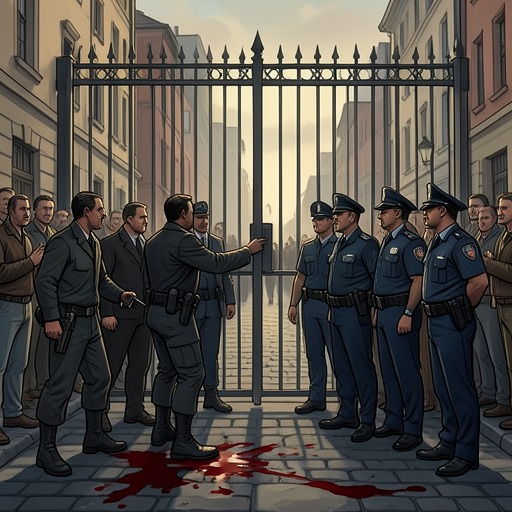
The response also reflects the limitations of official protection. After Conti’s death, police set up token roadblocks around Rome only several hours later and issued an alert for the American, but did not name Creasy or circulate his photograph. Cantarella asks whether the police and the Carabinieri are doing anything; Dicandia’s answer is that they are doing very little. Cantarella consequently orders his own network to monitor every point of entry into Sicily, including ports down to the smallest fishing village, airports, airstrips, and trains or cars arriving by ferry from Reggio di Calabria. The effort reaches beyond the villa because the danger, as Cantarella sees it, could arrive from any direction.
Orders and Implementation
At the estate, the plan combines distance, manpower, and controlled access. Cantarella orders floodlighting on the outer walls and two hundred meters beyond them, the purchase and razing of buildings within a one-kilometer radius, and patrols throughout the area twenty-four hours a day. Eighteen bodyguards are to be quartered at the villa and divided into three shifts. A roadblock half a kilometer from the gates is to stop every car for an interior and exterior search; no vehicle is allowed onto the grounds. Even other bosses and their emissaries may enter only alone and after a thorough search. The measures restrict not just a possible attacker but also the movement of Cantarella’s associates and visitors.
The plan is visible in the later account of its implementation. Trees between the orchard and the wall have been cut to create a lane, and the exterior floodlighting is operating, brightening the wall and the surrounding area for several hundred meters. The grounds themselves remain dark at night. Two Doberman pinschers, described as attack dogs trained to kill, have been delivered; armed guards with submachine guns watch the gate and the outer walls, while a small army is stationed inside. No vehicle of any kind is permitted even close to the walls. The resulting system layers warning, inspection, physical distance, and armed force, but does not illuminate every space it encloses.
The Orchard and the Cost of Fear
The most revealing order concerns not a gate or a weapon but Cantarella’s orchard. He commands that more than fifteen fruit trees along the inside of the walls be cut down. Twenty years earlier, when he bought the villa, he had personally supervised the planting. The orchard became a source of pride, and his entourage privately joked that the trees were his children. Cantarella’s wife had died childless thirty years before, and he never remarried. Against that history, ordering the trees destroyed marks the depth of his alarm: the security measures now take precedence over a possession invested with personal meaning.
The alteration of the orchard also makes the lockdown legible as a changing landscape rather than a list of instructions. The cut trees form a lane; the cleared space and outward-facing lights strengthen the exposed perimeter. At the same time, the grounds inside remain unlit, with guard dogs and armed men supplying protection there. The estate is being reshaped to control approaches, but its defenses depend on a division between the brightly watched outside and the dark interior.
Strategic Strength and Weakness
The novel sets Cantarella’s fixed perimeter against Creasy’s earlier, more mobile way of thinking about protection. When hired to guard Pinta, Creasy treats her as an asset and considers threats at the house, at other regular destinations such as the school, and along the route between them. On the Como–Milan road he looks for bends and isolated places where an attacker might stage an ambush; at Pinta’s school he notes the spike-topped walls, heavy gates, and lack of cover outside, then inspects the grounds. His approach attends to the target’s routine and the places where protection might fail, rather than relying on a single fortified location.
Guido recognizes that Creasy will know Villa Colacci’s layout and anticipate the defenses. He regards Cantarella’s choice to close himself in as a mistake: a soldier, he argues, would be safer moving around, and even the strongest fort can become a death trap once its walls are breached. This assessment does not erase the scale of the lockdown; it identifies its central weakness. The measures make the villa formidable from outside, but they also concentrate Cantarella and his protectors within a known space. In that contrast, the security plan becomes both a practical response to a real threat and an expression of fear that cannot be resolved simply by adding lights, dogs, searches, or guards.